We get asked this every fall, usually by someone who already owns a pancake compressor and is wondering why they'd pay someone else. It's a fair question and it deserves a straight answer, not a sales pitch. So: yes, you can blow out your own system. Whether you should depends on the compressor you have and how much you know about your own system.
Can you winterize a sprinkler system yourself?
Yes, if you have a compressor that delivers enough air volume — roughly 20 to 30 CFM — and you know where your shut-off, blow-out fitting and valves are. With a small shop compressor, no: it has the pressure but not the volume, and pushing harder to compensate is how valves and rotors get damaged.
The distinction that matters is volume, not pressure. A blow-out doesn't need much pressure at all — it needs a large, steady flow of air to carry water out of long runs of pipe. A big commercial compressor delivers that flow at low pressure. A small home compressor delivers a tiny trickle of air at high pressure, which is almost the opposite of what the job needs.
What size air compressor do you need to blow out sprinklers?
For a typical residential system with poly lines, plan on 20 to 30 CFM at around 50 PSI. Tow-behind rental units are 80 to 185 CFM and work easily. A 6-gallon pancake compressor produces about 2 to 4 CFM and will not clear a zone properly no matter how long you run it.
Here's why the small unit fails. When you open a zone with a pancake compressor connected, the tank dumps its air in a few seconds, the pressure drops, and then the compressor pump feeds the line at its true output — a few CFM. That's enough to push some water out of the heads nearest the valve. It is not enough to carry water out of the far end of a 30-metre run. The water settles back into the low spots, you assume the zone is clear because the near heads stopped spraying, and that's the water that freezes.
People try to fix this by running the tank up to 120 PSI and opening the zone repeatedly. Now you've got pressure spikes hitting the valve diaphragms and rotor gear drives with no volume behind them. That's the failure mode, not the fix.
What pressure should you use for a sprinkler blow-out?
Keep it at or below 50 PSI for poly lines, which is what nearly every system in Ontario uses. Never exceed 80 PSI on any irrigation system. Set the regulator before you open a zone, and never open a zone with the compressor tank at full pressure.
The heads are the giveaway on pressure. Rotors and pop-ups are designed for water pressure in a specific range; air at double that pressure with no water to cushion it will pop retraction springs, blow seals and, on rotors, spin the gear drive far faster than it's built for. Dry air also means no cooling — a rotor spinning on air for minutes at a time heats up and the gears go.
Two rules keep this manageable: regulator set first, and short bursts per zone. Once the last head is misting rather than spraying, the zone is done. Don't keep going.
What are the mistakes that turn a DIY blow-out into a spring repair?
Blowing through the backflow preventer instead of downstream of it, running zones dry for too long, using too much pressure with too little volume, leaving the manifold full, and standing over the heads. Any one of them can cost more than a professional closing.
In rough order of how often we see the results in April:
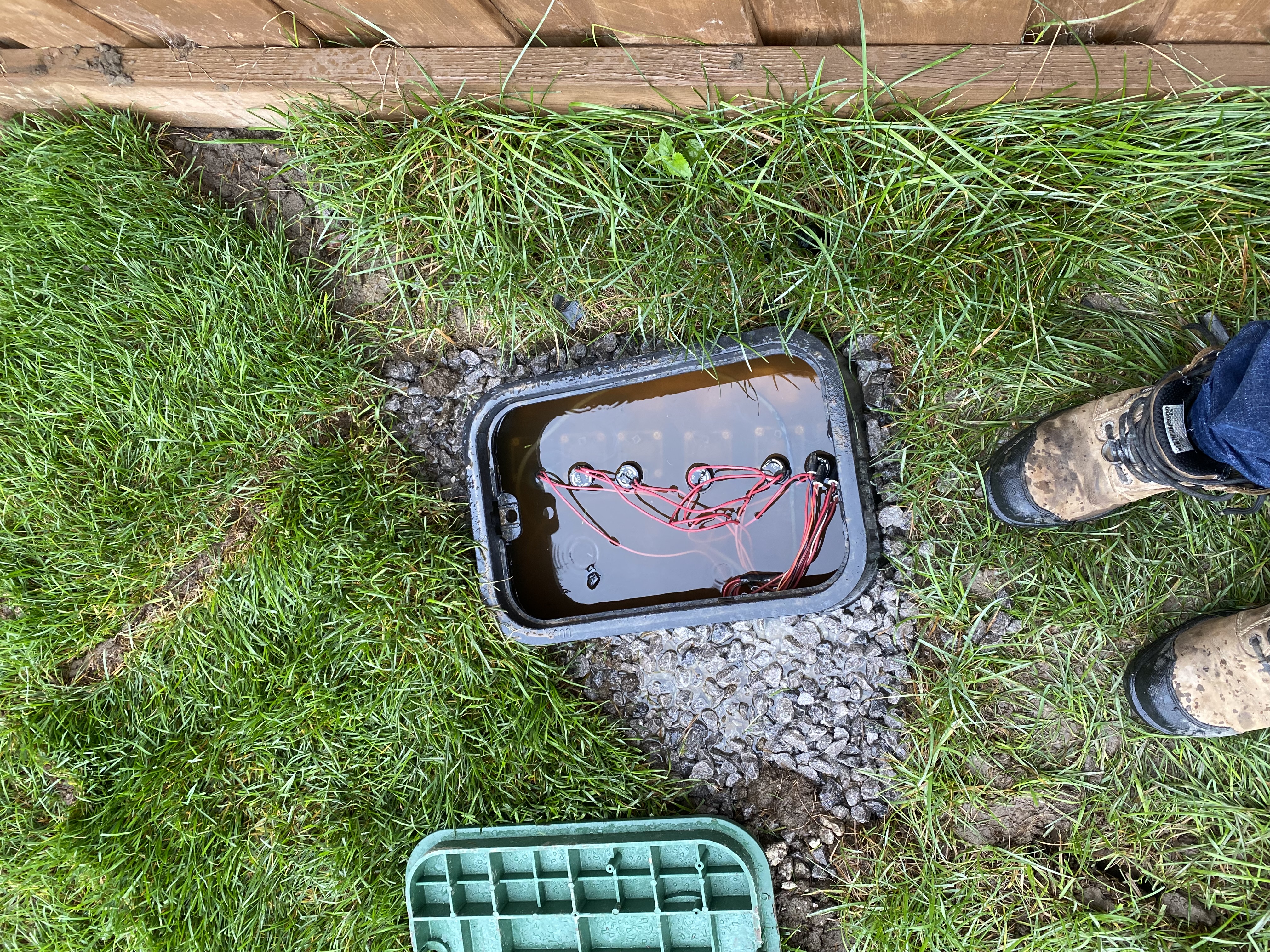
- Forgetting the manifold. Water shut off, zones blown, controller off — and the manifold between the shut-off and the valves still full. It cracks the first hard freeze. A manifold rebuild runs $135 for a three-valve box plus the $95 service call — already more than a professional closing.
- Air through the backflow. Never push shop-compressor air through the backflow preventer. Connect at the blow-out fitting downstream of it. High-pressure air through the check valves and relief port is a common way to damage an assembly. Clearing a backflow properly is a low-pressure, controlled step — we do it on every closing — not something a pancake compressor can do safely. And if your municipality requires backflow testing, that's a separate certified trade you'll be paying.
- Running a zone too long. See the rotor heat problem above. When the mist stops, stop.
- Not clearing the far end. The near heads stop spraying and you move on. The low spot at the far end of the run holds water, freezes, and splits a fitting. A pipe break repair is $120 plus the service call, and a bad DIY year can produce several.
- Standing over a head when the zone opens. Debris leaves a sprinkler head at speed under air. Eye protection, and stand back.
- Skipping the controller. The system's dry, but the schedule's still active. If someone reopens the main in a warm week, it fills and runs. Put the controller in winter mode — here's what that looks like.
If you've already had a bad blow-out and you're looking at a wet spot in the spring, here's how to find the break.
Can you winterize sprinklers without a compressor?
Not reliably in Ontario. Manual and automatic drain valves exist, but they only empty the lines that slope toward them, and most residential systems here weren't installed with full gravity drainage. Shutting off the water and opening drains is a start, not a winterization.
Some systems do have drain valves at the low points of each zone, and older installs occasionally have automatic drains that open when pressure drops. Even where they exist, they leave water in any section that doesn't fall toward the drain — and on a typical lot with a few grade changes, that's most sections. There's no substitute for pushing the water out with air.
What does a DIY blow-out actually cost?
A tow-behind compressor rental runs a hundred dollars or more a day plus a vehicle with a hitch, and it takes most of a morning the first time. A professional residential closing is flat-rate from $90 for up to four zones. For most homeowners, DIY costs more and carries the repair risk on top.
This isn't an argument that you can't do it. If you're comfortable with your system, have access to a proper compressor and want to do it yourself, you'll be fine following the rules above. It's an argument that the math rarely works out for a system with more than a couple of zones — and that the cheapest closing is the one where nothing cracks.
If you'd rather book it, the fall closing service is priced by zone count with no on-site quote. If you want to know what to have ready when the truck shows up, that's covered in how to prepare for your fall closing. Timing questions are answered in when to turn off your sprinklers in Ontario.
Frequently asked questions
Can I blow out my sprinklers with a pancake compressor?
Not properly. A 6-gallon pancake compressor delivers 2 to 4 CFM, far below the 20 to 30 CFM a residential zone needs. It will clear the near heads and leave water in the far end of every run.
What PSI do you use to blow out sprinklers?
Around 50 PSI for poly lines, which is nearly every system in Ontario. Never above 80 PSI. Set the regulator before opening a zone, and open zones with the tank already regulated rather than at full pressure.
How long do you blow out each zone?
Until the last head stops spraying and just mists — usually one to two minutes with adequate volume. Longer than that with no water in the line heats rotors and damages gear drives.
Do you blow out the backflow preventer?
On a professional closing, yes — it's cleared at low pressure so nothing sits in it over winter. On a DIY blow-out, don't: connect at the blow-out fitting downstream of it and never push high-pressure shop-compressor air through the assembly. Backflow testing and certification is a separate licensed Ontario trade.
Is it cheaper to winterize sprinklers yourself?
Usually not once you rent a compressor with enough volume. A professional closing starts at $90 flat-rate, and a single freeze-cracked valve or pipe repair costs more than that.
Rather have it done right the first time?
Flat-rate closing priced by zone count on the fall winterization page — see the number before you book. Add the spring opening and the same crew opens what it closed.
Book a fall closing